

Valo Therapeutics Announces Interim Phase 1 Clinical Data for PeptiCRAd-1 to Be Presented at ASCO 2026
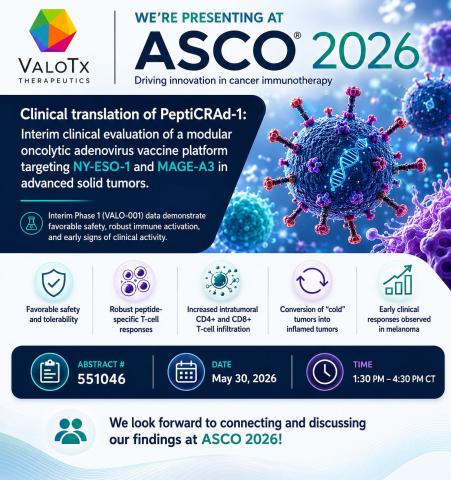
Interim VALO-001 results demonstrate encouraging safety profile, tumor-specific immune activation, and early clinical responses in advanced solid tumors
Valo Therapeutics announced that interim clinical data from the Phase 1 VALO-001 trial evaluating PeptiCRAd-1, the company’s modular oncolytic adenovirus vaccine platform targeting NY-ESO-1 and MAGE-A3, will be presented at the 2026 Annual Meeting of the American Society of Clinical Oncology (ASCO).
The presentation, titled “Clinical translation of PeptiCRAd-1: Interim clinical evaluation of a modular oncolytic adenovirus vaccine platform targeting NY-ESO-1 and MAGE-A3 in advanced solid tumors,” has been accepted as Abstract #551046.
Presentation Details
- Conference: ASCO Annual Meeting 2026
- Date: May 30, 2026
- Time: 1:30 PM – 4:30 PM CT
- Abstract Number: #551046
The interim analysis from the ongoing VALO-001 Phase 1 study demonstrated an encouraging safety and tolerability profile alongside evidence of robust tumor-specific immune activation. Preliminary findings also showed increased T-cell infiltration within tumors and early clinical responses in patients with advanced solid tumors.
PeptiCRAd-1 is based on Valo Therapeutics’ proprietary PeptiCRAd platform, designed to enhance antitumor immunity by coating oncolytic adenoviruses with tumor-targeting peptides. The current clinical candidate targets the cancer-testis antigens NY-ESO-1 and MAGE-A3, both widely expressed across multiple tumor types.
The VALO-001 study is evaluating the safety, immunogenicity, and preliminary antitumor activity of PeptiCRAd-1 in patients with advanced solid malignancies.
About PeptiCRAd-1
PeptiCRAd-1 is a first-in-class immunotherapy that leverages a peptide-coated, conditionally replicating adenovirus to stimulate tumor-specific immune responses. By combining oncolytic virotherapy with tumor-targeting peptides, this approach is designed to induce robust cytotoxic T-cell responses and enhance the efficacy of immune checkpoint inhibitors such as pembrolizumab enabling a novel therapeutic paradigm—effectively delivering “in vivo T-cell therapy” directly within the patient.